Small Claims Court

Tenants can use Small Claims Court to recover out-of-pocket costs related to housing, such as:

  • A withheld security deposit
  • Damaged or lost belongings
  • Unreimbursed expenses (e.g., repairs, overpayments)
  • Filing Fee: $15–$20
  • Maximum Claim: $5,000
  • Court Date: Usually scheduled within 30 days of filing
  • Filing Location: File where the landlord resides or works, not where the rental property is located (unless it’s the same).

⚠️ Important Note: Small Claims Court does not cover pain, suffering, emotional distress, or punitive damages.


How to Find Your Landlord’s Address

You cannot sue a landlord at a P.O. Box or via a property manager. The court requires a physical address for the owner.

If you don’t know where your landlord lives or works, try the following:

  1. AlbanyLandlord.com
    Look up your building to find the owner’s name and registered address.
  2. Tax Assessor’s Office
    Call the local tax assessor to get the primary residence address on file for your landlord.
  3. Code Enforcement Department
    They may have a physical address for the landlord on file, especially if there have been complaints or violations.
  4. City of Albany Residents
    Visit the Citizen Self Service Portal to find property ownership information.

What to Bring When Filing

  • Full name and address of the person or entity you’re suing
  • A description of the claim and the amount you’re seeking
  • Proof of costs (estimates, receipts, photos, etc.)
  • Any written communication (emails/texts) with the landlord
  • Code reports, if repairs or violations are involved

What to Expect in Court

  • Before the hearing, the judge will usually ask both parties to try settling the case in the hallway.
  • If no agreement is reached, the judge will set a date for trial (sometimes the same day, often a different date).
  • At trial, both parties present testimony and evidence.
  • The judge will decide whether to award the tenant money and in what amount.
  • If the tenant wins, the filing fee may also be refunded.

Tips for a Strong Case

  • Bring three reasonable estimates for each item you are claiming (optional, but strengthens your case).
  • Stay organized and clear in your explanation of events.
  • Always appear in court on time and with all documentation in hand.

Withholding Rent & Abatement Hearings

Tenants have the legal right to withhold rent when their landlord fails to provide safe and habitable housing. This right is protected under Real Property Law § 235-b, known as the Warranty of Habitability.


When Can Rent Be Withheld?

A tenant may choose to withhold rent if serious repair issues or code violations exist, such as:

  • No heat or hot water
  • Mold or persistent leaks
  • Unsafe wiring or pest infestations
  • Other major health or safety violations

Before withholding rent, the tenant must notify the landlord in writing of the issues and give them a chance to fix the problem. It’s also best practice to contact Code Enforcement to document the violations officially.

⚠️ Important Note: Put Withheld Rent in Escrow. Tenants should not spend the rent money they are withholding. Instead, set it aside in an escrow account or separate savings, in case the court requires you to pay some or all of it later.


What Happens If the Landlord Sues?

If a landlord sues for nonpayment, the tenant must appear in court and raise the issue of uninhabitable conditions. Tenants can request the court to:

  • Stay the eviction proceedings until repairs are made
    Based on RPAPL § 755
  • Reduce (abate) the amount of rent owed due to poor conditions
    Based on RPL § 235-b
  • Order repairs, especially when the landlord is trying to terminate the tenancy
    Based on UCCA § 203

What Should Tenants Bring to Court?

To prove their case, tenants should bring:

  • Official Code Enforcement reports
  • Photos (printed, ideally in triplicate)
  • Written communication with the landlord about the issues
  • Any receipts for repairs made or items replaced due to the condition

What Tenants Can Expect in Court

  • The court may require tenants to deposit some or all of the withheld rent before ruling on their case. This could happen at the first appearance.
  • If an abatement (rent reduction) is granted, it is often no more than 25%, unless conditions are extreme.
  • If the court sets a new amount owed, the tenant usually has one week to pay in full.
    • ✅ If paid: tenancy continues
    • ❌ If not paid: the eviction may proceed

⚠️ Risks of Withholding Rent

  • If you fail to appear in court or don’t have rent available when required, you may be evicted.
  • If you didn’t give notice to your landlord or didn’t have documentation, your defense may be weaker.
  • Withholding rent is risky without legal support or documentation—consult a tenant advocate whenever possible.

Retaliatory Eviction

Retaliatory Eviction Is Illegal. Landlords are prohibited from retaliating against tenants who exercise their legal rights. It is illegal for a landlord to evict a tenant or make substantial changes to their tenancy in response to the tenant taking certain protected actions.

What Counts as Retaliation?

It is illegal for a landlord to serve a Notice to Quit (or begin eviction proceedings) in retaliation for any of the following:

  • Filing a good faith complaint about:
    • Housing code violations
    • Duty of repair issues
    • Warranty of habitability
    • Any other housing-related legal violation
  • Taking legal action against the landlord (e.g. small claims or housing court cases)
  • Organizing or joining a tenant association or union

Rebuttable Presumption of Retaliation

If a landlord attempts to evict a tenant or change their lease within one year of the tenant taking one of the protected actions above, it is presumed to be retaliation, unless the landlord can prove otherwise. This is called a “rebuttable presumption.”

⚠️ Important Note: If the tenant owes rent or has violated the lease, a landlord may have valid grounds for eviction. In such cases, retaliation may be harder to prove, and the presumption may not apply.


Other Forms of Retaliation Are Also Prohibited

Landlords cannot substantially alter the terms of your tenancy as a form of retaliation, including:

  • Refusing to renew your lease or tenancy
  • Failing to offer a new lease
  • Increasing rent or decreasing services unjustifiably
  • Imposing new, burdensome rules targeting you after you’ve taken protected actions

14 Day Notices

A 14-day notice is issued by a Sheriff, Marshal, or Constable once the landlord obtains a signed warrant of eviction from a judge. This is the final step in the eviction process before physical removal.

⚠️ Important Note: Evictions can happen without a court process, but tenants have the right to defend themselves. If you never received notice to appear in court, you may be able to challenge the eviction with an Order to Show Cause (OTSC). UTA can help you fill one out.


What Happens When a 14-Day Notice Is Served?

  • The 14-day notice must be triggered by a signed warrant of eviction issued by a judge.
  • A live warrant allows the landlord to bring the warrant to the Sheriff, who will then serve the 14-day notice via mail, posting, or personal delivery.
  • The 14-day period includes weekends and holidays, but the lockout cannot occur on those days.
  • Evictions can only happen on business days, during daylight hours.

If You’ve Received a 14-Day Notice

  • Start preparing immediately. Pack important documents, medications, and valuables.
  • After the 14 days expire, the Sheriff will come to change the locks. At that point, the apartment is no longer legally in your possession.
  • If you fully complied with a court agreement but still received the notice, go to court immediately and file an OTSC.

Rights in Nonpayment of Rent Cases

In a nonpayment eviction, the tenant has the right to pay all rent owed up to the time of the eviction to stop the lockout.

  • Bring full payment (not partial) to court or directly to the landlord, preferably with proof.
  • If you are on a payment stipulation and miss a payment by even a day or a dollar, the landlord may proceed with eviction without going back to court.

After the Lockout

  • The landlord is responsible for keeping your belongings safe and dry for a reasonable time (typically 14–30 days).
  • This does not mean you get to stay in the unit.
  • Landlords cannot hold your items for ransom, but they can charge for storage if they place your items in a unit.

Emergency Shelter After Eviction

New York is a Right to Shelter state. You cannot be left without a place to go.

  • Before 4:30 PM (weekdays): Go to the Albany County Department of Social Services, 162 Washington Ave.
  • After 4:30 PM or weekends/holidays: Contact Homeless and Travelers Aid Society (HATAS) at 138 Central Ave or call 518-463-2124 for emergency shelter help.

Illegal Lockouts

It is illegal for a landlord to evict you without a court process and a 14-day notice.

If You’re Locked Out Without Notice:

  1. Call your local court to see if a case was filed and if a judgment was entered.
    • If yes: You may need to file an Order to Show Cause (OTSC)
    • If no case was filed: This is likely an illegal lockout
  2. Call the police non-emergency line and request assistance getting back into the home.
  3. Breaking in with police assistance is legal in an illegal lockout.
  4. Ask the officer to complete a Significant Incident Report (SIR).
    • Get the officer’s name and badge number
    • If the officer is reluctant, persist politely but firmly

🚨 Illegal lockouts are a Class A Misdemeanor. You can also sue the landlord for damages.


Money Judgments

Eviction cases can result in a money judgment for unpaid rent. There are two types:

1. Possessory Judgment

  • The tenant must pay the amount owed to remain in the unit.
  • Nonpayment results in eviction.
  • Often ordered as a lump sum or installments.

2. Non-Possessory Judgment

  • The court awards the landlord money owed, but the tenant doesn’t have to move out.
  • These usually apply when the lease has already ended or the tenant is no longer in the unit.

Money judgments can have consequences such as:

  • Damaged credit
  • Frozen bank accounts
  • Wage garnishment (typically 10% of gross income)
  • Added fees from the Sheriff or Marshal
  • Harder to rent future housing
  • Cycle of eviction and unsafe housing
  • Less access to homeownership
  • Long-term financial impact, especially for BIPOC communities
  • Judgments accrue 9% interest and remain valid for 20 years
  • Rarely covered by Social Services, seen as non-emergency debt

Order to Show Cause

An Order to Show Cause (OTSC) is a legal tool tenants can use to ask the court to reopen or review a case, especially if something went wrong in the court process. Filing an OTSC is free in City and Town Courts in New York.


When Can a Tenant File an OTSC?

1. If the Tenant Missed a Court Date

If a tenant did not appear at their scheduled court hearing, they may file an OTSC to:

  • Explain why they missed court (such as not being properly served court papers)
  • Ask for another chance to appear and present their case

Example:
A tenant receives a 14-day eviction notice but never got the court papers beforehand. They had no idea there was a court case and missed the appearance. An OTSC can be filed to reopen the case and explain what happened.

2. If the Tenant Appeared but the Landlord Didn’t Follow the Agreement

Tenants can also file an OTSC after attending court, if:

  • They followed the terms of a stipulation (court agreement) but still received a 14-day eviction notice
  • The landlord violated the agreement, such as failing to make agreed-upon repairs or refusing a payment that was due under the stipulation

Example:
The tenant paid the rent as agreed in the settlement, but the landlord still sent a notice of eviction. Or, the landlord promised to repair something and did not. An OTSC can help the court review and enforce the original agreement.


Using an OTSC in Small Claims Court

OTSCs are also used to vacate a default judgment in Small Claims Court. This is often necessary when:

  • A tenant didn’t know a case was filed and later learns a judgment has been entered against them
  • The landlord sued at an old address, so the tenant was never notified

Steps:

  1. The tenant should call the local court to check if a claim was filed.
  2. If a case exists and a default judgment was entered, the tenant can file an OTSC to try to reopen the case.
  3. If no case was ever filed, but a judgment appears on the tenant’s record, legal advice is recommended.

What’s in an OTSC Application?

When completing the OTSC, tenants must explain:

  • Why they missed court or believe the case should be reviewed
    (e.g. improper service, mistake by the landlord or court)
  • What their defense or argument is
    (e.g. they paid rent, landlord broke agreement, case was filed in error)

The court will review whether the tenant has a valid reason for reopening the case and whether they have a potential defense.

Even if a tenant had a good reason for missing court, the judge may deny the OTSC if the tenant has no legal defense or no way to resolve the issue, such as being unable to pay undisputed rent arrears.

What Happens After an OTSC Is Filed?

If the judge signs the OTSC, the following steps usually apply:

  1. The tenant must serve:
    • The Sheriff, to stop the 14-day eviction notice
    • The landlord, using a disinterested third party
  2. An affidavit of service must be filed with the court to confirm service
  3. A new court date will be scheduled
  4. Both parties will reappear in court to “show cause” (explain their side)

At that point, the case will proceed like any other housing court case: the tenant and landlord may try to settle or proceed to trial.

Court Process

(Service, First Appearance, Settlements, Trials)

Once a landlord has served the proper notice (such as a rent demand, notice to cure, or 30/60/90-day termination notice) and the lease or notice period has expired, they can file for eviction in the local court where the apartment is located.


Service of Court Papers

  • Court papers must be served 10–17 days before the court date.
    • If papers are served too early or too late, the tenant may be able to have the case dismissed.
  • Papers must be served by a disinterested third party, and may be delivered by:
    • Certified mail
    • Regular mail
    • Personal delivery

After Papers Are Served

  • The tenant should prepare to attend the court date.
  • If the tenant does not appear, the judge may issue a:
    • Default eviction (warrant is issued immediately)
    • Money judgment for unpaid rent

Even after a default judgment, the landlord must still go to the Sheriff’s Office to serve the tenant a 14-day notice to vacate. Except in rare cases, tenants should always receive this notice before being evicted.

Important service rules:

  • No servicing can take place on on Sundays
  • Papers must go to someone of “suitable age” (typically 14 or older)
  • Papers cannot be served at the tenant’s workplace
  • An affidavit of service must be filed to confirm proper delivery. If this is not done, the case can be dismissed.

Resolving Nonpayment Cases

  • If a tenant pays all the rent owed before the court date or eviction, the case should be dismissed. If this is the case, the tenant should call the court to confirm the case has been withdrawn.
  • If the landlord refuses payment after the eviction warrant was granted by the court, the tenant can file an Order to Show Cause to prevent the eviction.
  • If a tenant misses court for a good reason, they should file an Order to Show Cause immediately.

Court Filing & Attorney Fees

  • If the landlord wins the case, they are usually entitled to recover the $45 court filing fee.
  • During settlement negotiations, this fee is often used as leverage—it can be waived or split.
  • Judges generally do not tie the filing fee to the eviction outcome, but this varies by court.
  • Attorney fees should not be tied to an eviction case. The landlord may request this but tenants can refuse.

First Court Appearance

Tenants are entitled to an adjournment – often for 14-days – but it must be requested in person during the first appearance. Tenants should explain the reason for the request. For example, “I need time to find a lawyer”, or “I’m working with another agency that may be able to pay my rent”. It is not common that a tenant receives more than one adjournment.

If a Settlement is Reached

Most housing court cases are settled outside the courtroom (often in the hallway). These agreements are legally binding and become court orders. Common types include:

“Stayed Pending Payments”Payment Plans

The tenant agrees to make regular payments toward both back rent and current rent.

  • A warrant of eviction is still issued but paused (or “stayed”) as long as payments are made on time.
  • Missing a payment—even by a small amount or a single day—allows the landlord to move forward with the eviction.
  • If the tenant catches up on missed payments, the eviction can be stopped.

“Warrant with Stay” – Vacating by Agreement

The tenant agrees to move out by a set date and may forfeit their security deposit in exchange for extra time.

  • A warrant of eviction is issued, but it is paused until the agreed move-out date.
  • If the tenant stays beyond that date, the landlord can immediately execute the warrant.

“Lockout Warrant”

The tenant agrees to leave by a set date.

  • After that date, the landlord may proceed with the lockout immediately.
  • No 14-day Sheriff’s notice is required if the tenant remains past the agreed-upon date.
If No Settlement is Reached

Tenant Has Legal Defenses

  • The tenant may request a 14-day adjournment to:
    • Seek legal help
    • Gather evidence
  • A trial may be scheduled if there is a dispute over:
    • The amount of rent owed
    • Code violations or habitability issues
    • How the court papers were served

Tenant Has No Legal Defense

  • The judge may issue:
    • An eviction order
    • A money judgment for unpaid rent
  • The judge may allow additional time to move out, but this is not guaranteed.

Trial

If no agreement is reached, the case goes to trial. Both sides present evidence, and the judge makes a decision.

Tenants should bring:

  • Receipts showing rent was paid
  • Photos or videos of housing/code violations
  • Copies of communication with the landlord (texts, emails, letters)
  • At least three printed copies of all evidence to submit to the court

Eviction Types

Nonpayment of Rent

Tenants have a 5-day grace period before a rent payment is considered late.
Once rent is late:

  • The landlord must send a 5-day late rent notice to the tenant.
  • The landlord must also issue a 14-day rent demand (often delivered by mail), stating the tenant must pay or vacate the unit within 14 days.

⚠️ Important Note: Tenants cannot be evicted for failing to pay late fees—only for unpaid rent.


Holdovers

Staying Past the End of Tenancy

This applies in two scenarios:

  1. The tenant had a fixed-term lease (e.g., a 12-month agreement) that has expired.
  2. The tenant is month-to-month and has received proper written notice to vacate. (See section: Month-to-Month Lease)
  • Lease termination notices do not need to be notarized or formal, but must be in writing.
  • If you live outside a locality with Good Cause Eviction, the landlord does not need to give a reason for ending your lease.
  • In the City of Albany and other Good Cause municipalities, landlords must provide a valid reason and cannot simply choose not to renew (see Good Cause Eviction section).
  • If your landlord claims you’re not protected by Good Cause Eviction, they must provide written documentation stating why.

⚠️ Important Note: Receiving a lease termination does not remove the tenant’s obligation to pay rent up to the last day of the tenancy.

Once proper notice has been served and the tenant remains in the unit:

  • The landlord may file a holdover eviction.
  • If the tenant pays rent after the termination date and the landlord accepts the payment, the holdover is invalidated and the landlord must start the process over.

Breach of Lease

If a landlord claims a serious violation of the lease, they must:

  • Provide a written notice to cure, giving the tenant 3, 5, or 10 days (depending on the lease language) to correct the issue.

If the tenant fixes the problem, the issue is resolved.
If not:

  • The case can go to court.
  • If the court finds the tenant did violate the lease, the tenant will usually be given 30 days to correct the violation.
  • If the tenant still does not comply, eviction is likely.

Squatters

A property owner may begin a squatter eviction if there is no landlord-tenant relationship with the occupant.
This may happen if:

  • The owner bought the property in a foreclosure sale.
  • The occupant moved in as a guest but never signed a lease.
  • The occupant moved in without permission as a squatter.

In these cases, the owner must serve a 10-day Notice to Quit, telling the occupant to vacate or be taken to court.

Health Hazards (Infestations, Mold, and Lead)

General Infestation Policy

Unless it can be proven that the tenant caused the infestation, it is the landlord’s responsibility to address and resolve pest issues.

  • If a tenant is found to be the cause, they may be responsible for remediation costs.
  • Tenants must comply with reasonable instructions from the landlord or pest control company.
  • If an infestation is not addressed, tenants should call Code Enforcement.
  • Severe infestations may lead to a unit being declared Unsafe-Unfit.

Bed Bugs

Under New York State law:

  • Landlords are responsible for keeping the unit free of insects and vermin.
  • Landlords are expected to cover the full cost of extermination for bed bug infestations—unless they can prove the tenant caused the issue.
  • Tenants must comply with instructions from Code Enforcement and exterminators during treatment.

Mold

Code Enforcement often does not cite mold itself, but instead cites the underlying causes, such as:

  • Leaks
  • Poor ventilation
  • Broken or missing windows

If you’re concerned about mold:

  • Consider contacting a third-party inspector, such as Alpine Environmental Services or Enviro Test Inc.
  • If you are experiencing respiratory or other health issues, consult a doctor or specialist who may be able to document the habitability issue.

Lead

If you suspect lead in your unit:

  • Contact the Albany County Health Department’s Environmental Unit, which offers free testing for households with:
    • A child under the age of 6
    • A pregnant resident

If lead is found:

  • The landlord has 14 days to provide an action plan.
  • Once the plan is submitted:
    • Indoor lead hazards must be fully resolved within 6 weeks.
    • Outdoor lead hazards also require full remediation within 6 weeks, unless it’s winter, in which case more time may be permitted.

⚠️ Important Note: Lead is especially dangerous to young children, but it can also cause serious harm to adults.

Important: If your lease did not include a lead disclosure and lead is later found in the unit, you may be entitled to sue the landlord for damages.

Non-Emergency code violations

What to Do When Repairs Are Needed

1. Notify Your Landlord Immediately (In Writing)

If something in your unit needs repair, you should notify your landlord as soon as possible—and always in writing.

  • A text message is acceptable at first.
  • If you don’t get a response, send a formal letter by certified mail so you have proof of communication.
  • Keep a copy of the letter and allow the landlord a reasonable amount of time to address the issue.

2. Call Code Enforcement if the Landlord Doesn’t Act

If the landlord fails to respond or fix the issue:

  • Contact Code Enforcement to file a complaint.
  • Be present during the inspection if possible, so you can point out all unresolved problems.
  • Request a copy of the inspection report from Code Enforcement.
  • In Albany, you can also find the report on the Citizen Self Service Portal.
  • If Code Enforcement finds violations, the landlord will be given a deadline to make repairs.

3. Re-Inspection by Code Enforcement

Once the deadline passes:

  • If the landlord has made the necessary repairs, the case is closed.
  • If the landlord hasn’t taken action—or the work is not satisfactory—the case is referred to prosecution.

4. Prosecution (City Takes Landlord to Court)

  • The City of Albany will petition the landlord and bring them to housing court.
  • A judge may settle the matter or set a trial date.

What Tenants Can Do

  • Under the Tenant Dignity and Safe Housing Act, tenants have the right to sue their landlord for:
    • Needed repairs
    • Rent abatements (partial refunds)
    • Money judgments and more
  • If you’re considering legal action, call United Tenants of Albany (UTA) and we can walk you through the process.

What About Withholding Rent?

Tenants may choose to withhold rent if repairs are not being made—but be cautious:

  • The landlord can still try to evict you for non-payment.
  • However, if you’re able to pay the amount the judge determines is owed, you cannot be evicted.

Good Cause Eviction

Good Cause Eviction is a New York State law that only applies in localities that have opted in to the protection. That means your village, town, or city must pass a local law adopting Good Cause before you are covered.


What Good Cause Eviction Does

Good Cause Eviction provides two key protections:

  1. Limits your landlord’s ability to evict you without a valid reason
  2. Caps the amount your landlord can raise your rent within a given year

Where Good Cause Eviction Applies (as of April 23, 2025)

New York City (Brooklyn, Bronx, Manhattan, Queens, Staten Island), City of Albany, City of Beacon, City of Binghamton, City of Ithaca, City of Kingston, City of Poughkeepsie, City of Rochester, City of Hudson, City of Newburgh, Town of Poughkeepsie, Village of Catskill, Village of Croton-on-Hudson, Village of Fishkill, Village of New Paltz, Village of Nyack


1. Lease Renewal Rights – Limited Eviction Grounds

Tenants in good standing have the right to automatic lease renewals. A landlord cannot refuse to renew a lease without one of the following legal reasons:

  • You owe rent
  • You violated the lease
  • You are creating a nuisance
  • You are using the property for illegal activity
  • You are unreasonably denying the landlord access to the unit
  • The landlord or their family needs to move into the unit
  • The landlord plans to demolish the property
  • The landlord plans to remove the unit from the rental market
  • You refuse to accept reasonable changes to the lease

2. Limits on Rent Increases

Under Good Cause Eviction, landlords cannot impose unreasonable rent increases.

Rent increases are capped at:
5% + the local Consumer Price Index (CPI) or 10%, whichever is less.

Example – Albany CPI (as of April 23, 2025): 3.38%

  • Maximum increase allowed: 5% + 3.38% = 8.38%

All eviction claims must go through court. A judge must determine if the landlord’s reason is valid.


Rent Increase Examples

Example A

  • Current Rent: $1,000/month
  • CPI: 3.38%
  • Maximum legal increase: $1,083.80
    (8.38% of $1,000 = $83.80)

Example B

  • Current Rent: $1,000/month
  • CPI: 8% (hypothetical future date)
  • Capped Increase: 10% → $1,100/month
    (Even though 5% + 8% = 13%, the increase is capped at 10%)

Example C

  • Current Rent: $1,000/month
  • CPI: 3.38%
  • Landlord demands: $1,150 (15% increase)
  • Context: Landlord renovated the bathroom and added new appliances
    → This may justify a higher increase, but it must be proven in court. You have the right to challenge it.

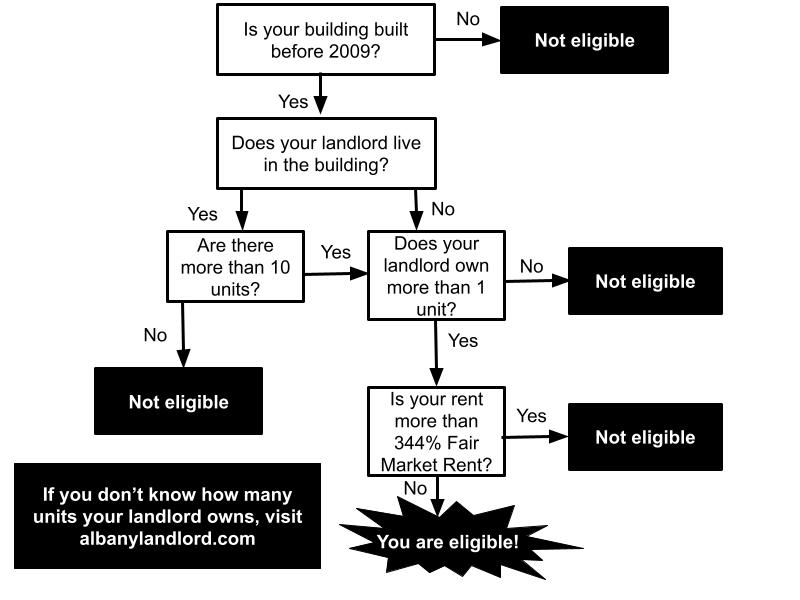
Carve Outs for Landlords

Importantly, there are many carve-outs for landlords. Below is a chart to simplify the protection:


What to Do if Your Rent Increase Seems Unreasonable

If your landlord raises your rent beyond the legal limits—or refuses to renew your lease without a valid reason—you may be protected under Good Cause Eviction. Contact United Tenants of Albany immediately to get support.